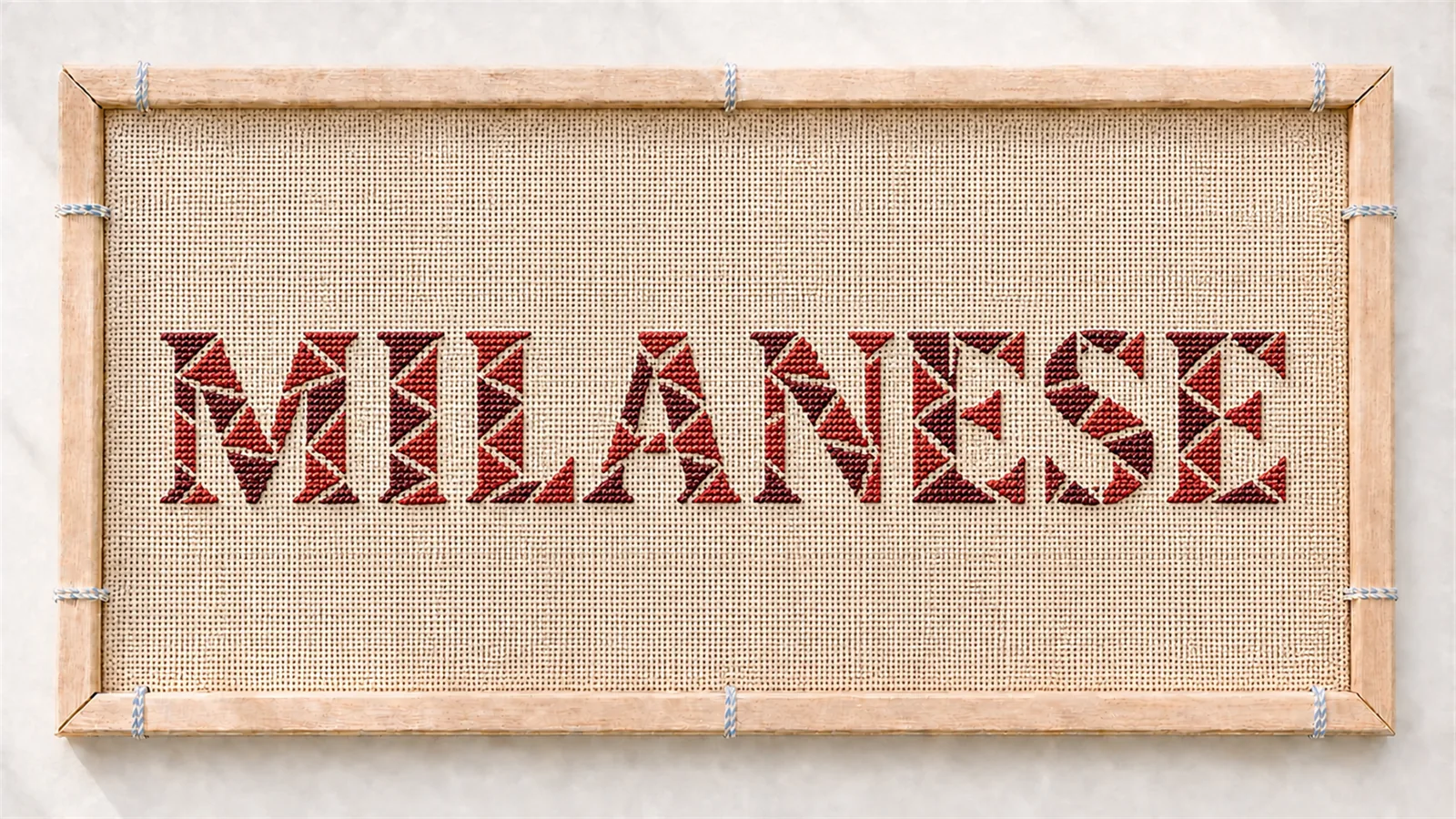
Triangles of graduated diagonals — over one, two, three, four — that reverse row to row and tessellate into a bold arrowhead pattern. One of the most striking backgrounds you can stitch.
The beauty portrait — the stitch spelled in its own texture. Same frame and crop across every stitch in the library.
What the texture looks like
Worked up close: triangles of four graduated diagonals — over one, two, three, four — adjacent rows reversed into rows of arrowheads.
Difficulty
Ready for more Graduated diagonals in triangles.
Appearance
A bold arrowhead pattern of nesting triangles.
Coverage
Excellent — covers quickly with strong movement.
Pattern repeat
Four graduated diagonals per triangle; adjacent rows mirrored.
Good for
Large backgrounds · dramatic geometric fills.
You’ll need
Tapestry needle · thread that fully covers 13-mesh canvas · one color for practice.
Exactly how to make it
Make one triangle
Completed stitches are shown in blush, the stitch in progress in red, and the next hole circled in blue. Four diagonals — over one, two, three, four — make a triangle.
1
Come up at 1, go down at 2 — a short diagonal over one intersection.
2
Come up at 3, go down at 4 — a longer one over two canvas threads (spanning two threads), from the same edge.
3
Come up at 5, go down at 6 — longer still, over three.
4
Come up at 7, go down at 8 — the longest, over four. Four graduated diagonals make a triangle.
Build the pattern
Reversing the next row
One row of triangles all point the same way. The next row is worked in reverse and tucked in so the smallest stitch of one row sits against the largest stitch of the adjoining row — that mirroring is what locks the triangles into the bold arrowhead repeat.
Row one — two triangles, each four graduated diagonals over one, two, three, four.The next row reverses and nests, small stitch meeting large. The arrowhead pattern appears.
This is normal: counting the growing diagonals — one, two, three, four — feels slow for the first triangle or two. Then the arrowheads start to march and your eye keeps the count for you.
What yours should look like
Front and back
Front — tessellating triangles in an arrowhead pattern.Back of this worked sample (schematic) — carries stepping between the triangles.
Common mistake — and the fix
Grow the diagonals in strict order — one, two, three, four — and reverse the next row so its smallest stitch meets the largest of the row before. Break the sequence and the triangles stop nesting into arrowheads.