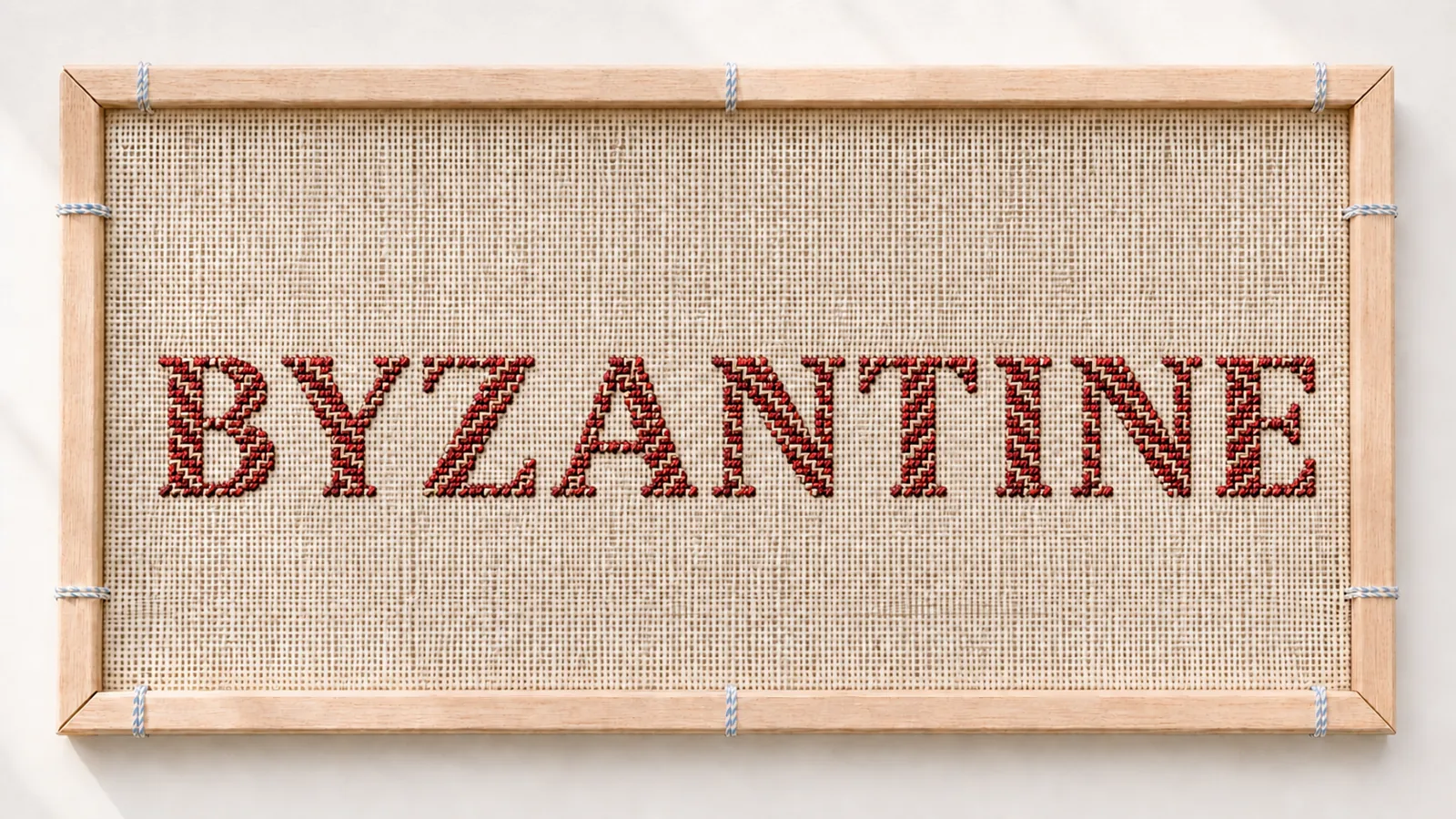
Long slanted stitches over four intersections, worked in five-stitch legs that turn at right angles — wide satin bands that stair-step across the canvas. Striking, rhythmic, and a favorite for backgrounds.
The beauty portrait — the stitch spelled in its own texture. Same frame and crop across every stitch in the library.
What the texture looks like
Worked up close: long slanted stitches in equal five-stitch legs that turn at right angles, the bands interlocking at their corners into a bold, stepped satin fill.
Difficulty
Ready for more A diagonal counted pattern.
Appearance
Bold satin bands stepping diagonally across the canvas.
Coverage
Excellent — the long slanted stitches cover quickly and evenly.
Pattern repeat
Five stitches over four intersections per leg; legs turn 90°.
Good for
Large backgrounds · borders · geometric fills.
You’ll need
Tapestry needle · thread that fully covers 13-mesh canvas · one color for practice.
Exactly how to make it
Make one leg
Completed stitches are shown in blush, the stitch in progress in red, and the next hole circled in blue. Five long diagonal stitches to a leg, then a right-angle turn.
1
Come up at 1, go down at 2 — a long diagonal stitch over four canvas intersections (crossing four threads each way).
2
Come up at 3, go down at 4 — the next steps one unit along, parallel — the run begins.
3
Come up at 5, go down at 6 — the third of the run.
4
Come up at 7, go down at 8 — the fourth.
5
Come up at 9, go down at 10 — the fifth is the corner stitch — five to a leg.
6
Come up at 11, go down at 12 — turn ninety degrees and begin the next leg from that shared corner (below).
Build the pattern
Turning the staircase, then filling
Each leg is five long diagonal stitches in a straight run. At the fifth — the corner stitch, shared by both legs — you turn ninety degrees and work the next five. Alternating legs builds one zigzag band; the next band then fits into its open steps so the corner stitches meet and the bands become a continuous fill.
One leg — five diagonal stitches, each over four intersections, in a straight run.At the corner the band turns and runs the other way — one zigzag band.The next band fits into the open steps of the first. Their corner stitches meet, turning separate zigzags into a continuous fill.
This is normal: counting five to a leg is the whole trick. Remember the corner stitch belongs to both legs, so you add four more after it — keep the count even and the staircase stays true.
What yours should look like
Front and back
Front — two and three bands interlocking at their corners into a bold zigzag fill.Back of this worked sample (schematic) — long carries following the stepped diagonal.
Common mistake — and the fix
Count five stitches in every leg, remembering that the corner belongs to both legs. When you add the next row, fit it into the steps so the corner stitches meet. A missed corner count makes the band drift.