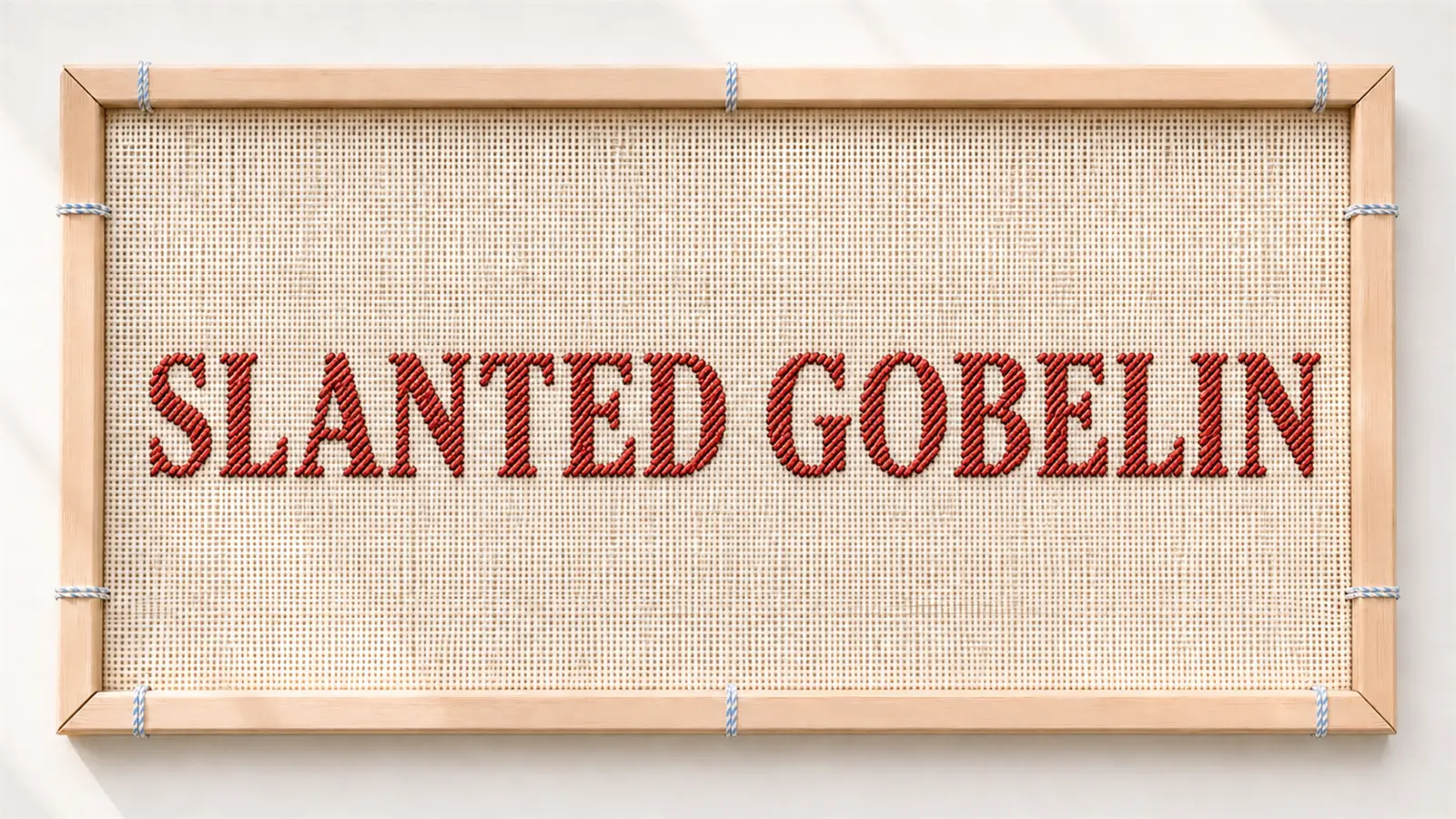
The slanted cousin of Straight Gobelin (also called Oblique Gobelin) — an even oblique stitch over one thread across and two up, worked in smooth rows. Fast, elegant, and a little dressier than tent.
The beauty portrait — the stitch spelled in its own texture. Same frame and crop across every stitch in the library.
What the texture looks like
Worked up close: even slanted stitches, each over one thread across and two up, lined up in smooth oblique rows.
Difficulty
Beginner A longer, slanted straight stitch.
Appearance
Smooth, even oblique rows — a soft diagonal ridge.
Coverage
Covers faster than tent because each stitch is longer. Use a thread with enough body to cover the canvas.
Pattern repeat
One slanted stitch over 1×2, worked in stacked rows.
Good for
Backgrounds · borders · bands · dressier fills.
You’ll need
Tapestry needle · thread that fully covers 13-mesh canvas · one color for practice.
Exactly how to make it
Make one row
Completed stitches are shown in blush, the stitch in progress in red, and the next hole circled in blue. Each stitch slants over one thread across and two up.
1
Come up at 1 (top-right), go down at 2 (bottom-left) — a slanted stitch over one thread across and two up (spanning two threads tall), worked top-right down to bottom-left — steeper than a tent stitch.
2
Come up at 3, go down at 4 — the next, one hole to the right, the same slant.
3
Come up at 5, go down at 6 — keep the angle identical.
4
Come up at 7, go down at 8 — a smooth, even oblique row.
5
Come up at 9, go down at 10 — longer than tent, so it covers faster.
6
Come up at 11, go down at 12 — the row is done. Worked this way the thread lays a long diagonal on the back. Now start the next row directly below (see below).
Build the pattern
Turning at the end of a row
One row of slanted gobelin is a smooth oblique ridge. The second row sits directly below it, worked at exactly the same angle, so the ridges stack into even bands. Keep the slant identical row to row and the whole field reads as one soft diagonal grain.
Row one — even oblique stitches, each over one thread across and two up.Row two directly below, same slant. The rows stack into smooth, even bands.
This is normal: the steeper slant feels different from tent for a stitch or two. Keep every stitch at the same angle and the row reads as one smooth diagonal.
What yours should look like
Front and back
Front — smooth, even oblique rows.Back of this worked sample (schematic) — long diagonal carries, the canonical slanted-gobelin reverse.
Common mistake — and the fix
Keep the slant identical on every stitch. Because these are longer than tent, a stitch at the wrong angle shows more — and longer stitches are a little more exposed to snagging, so a thread with body helps them wear well.