Smyrna cross is a raised four-stitch unit: make a diagonal X, then place an upright plus on top. Repeated in rows, the units form a firm, jewel-like texture. Also called double cross or Leviathan stitch.
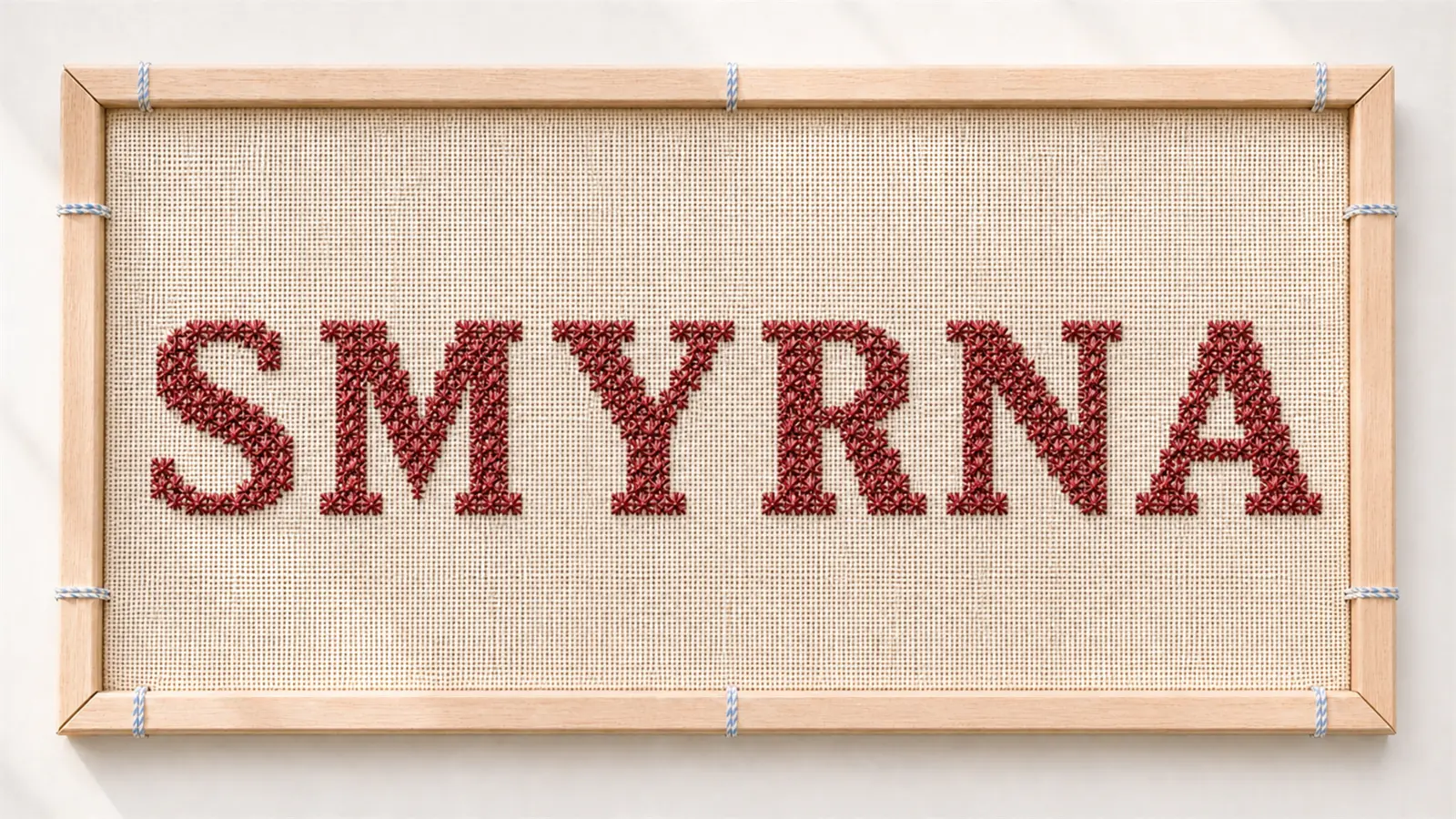
The beauty portrait — the stitch spelled in its own texture. Same frame and crop across every stitch in the library.
What the texture looks like
Worked up close: a grid of raised, boxed crosses — an X with a plus stitched over it, four stitches to each one.
Difficulty
Ready for more Four stitches per unit.
Appearance
Raised, jewel-like boxed crosses in an even grid.
Coverage
Excellent and dimensional — four stitches cover every unit richly.
Pattern repeat
Four stitches per two-by-two unit; units aligned in a grid.
Tapestry needle · thread that fully covers 13-mesh canvas · one color for practice.
Exactly how to make it
Make one raised cross unit
Completed stitches are shown in blush, the stitch in progress in red, and the next hole circled in blue. One unit is four stitches: an X, then a plus on top.
1
Come up at 1, go down at 2 — the first diagonal of an X, corner to corner over two canvas threads (spanning two threads).
2
Come up at 3, go down at 4 — the second diagonal completes the X.
3
Come up at 5, go down at 6 — an upright vertical straight over the center of the X.
4
Come up at 7, go down at 8 — a horizontal across it. The upright cross sits on top of the X — one raised cross unit.
Build the pattern
From one unit to a filled grid
Each Smyrna is a self-contained raised cross unit that sits on its own two-by-two square. To fill an area you simply repeat it — the next unit directly beside the first, the next row directly below — so the boxed crosses line up in an even grid.
Two units side by side — each a diagonal X with an upright cross on top.A second row beneath the first. The raised crosses align into a regular grid of jewel-like boxes.
This is normal: the top cross wants to slide off the X at first. Keep all four stitches sharing the same center and each unit squares up into a tidy little box.
What yours should look like
Front and back
Front — a grid of raised, boxed crosses.Back of this worked sample (schematic) — short carries between the units.
Common mistake — and the fix
Always work the X first and the upright cross on top — never the reverse. The order is what makes the unit sit up; flip it and the crosses look flat and messy.